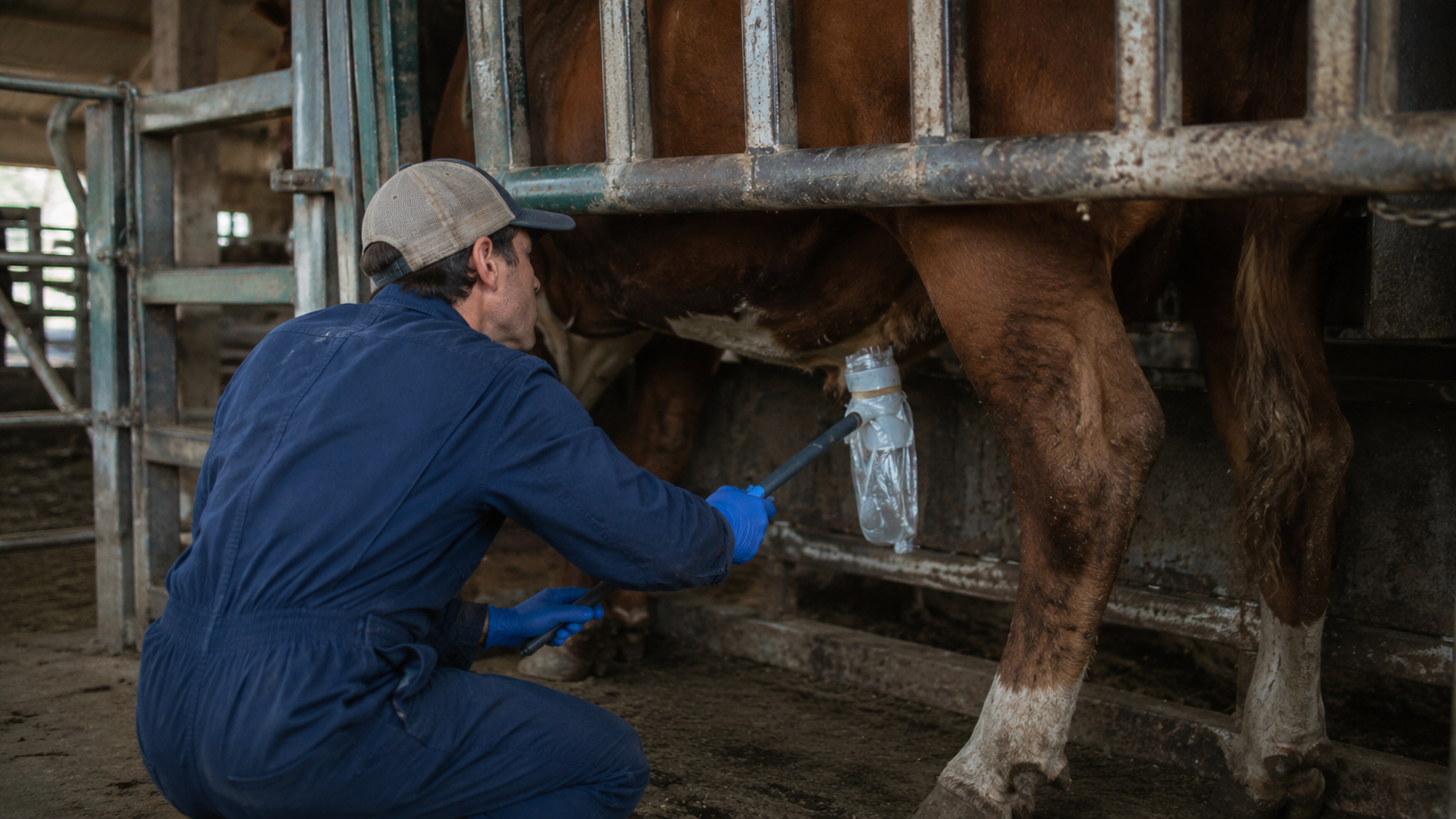
Sperm motility is the number every breeding decision leans on. A technician checks it first. A certificate leads with it. It is the value most tied to whether a cow gets pregnant. Yet ask two people what "motility" means and you get two different answers. One means any movement. Another means forward movement. A lab means a dozen measured velocities.
That confusion costs pregnancies. A dose called "80 percent motile" can still fail if most of that movement is not progressive. This article lays out what sperm motility actually measures, how it is evaluated, and the field standards that separate a usable dose from a wasted straw.
What sperm motility is, and why it matters
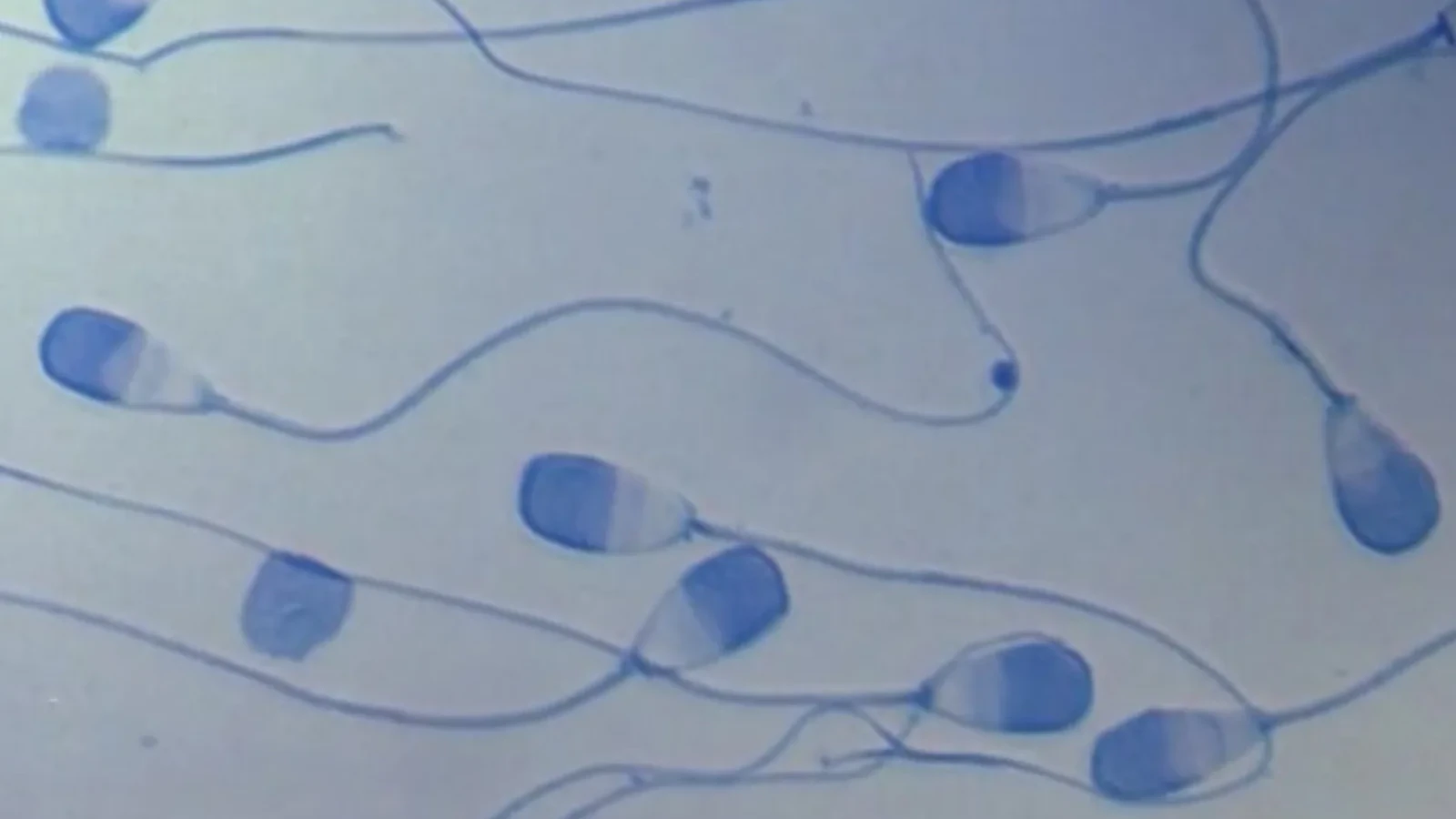
Sperm motility is the proportion of sperm that are moving, and how they move. It matters because a sperm cell has one job that depends on movement: reaching and fertilizing the egg. A dead or sluggish sperm carries the same DNA as a fast one, but it never arrives.
Total motility is the share of sperm showing any movement at all. Progressive motility is the share moving forward in a straight or nearly straight line. Progressive is the one that predicts fertility, because only forward-swimming sperm travel the female tract to the site of fertilization.
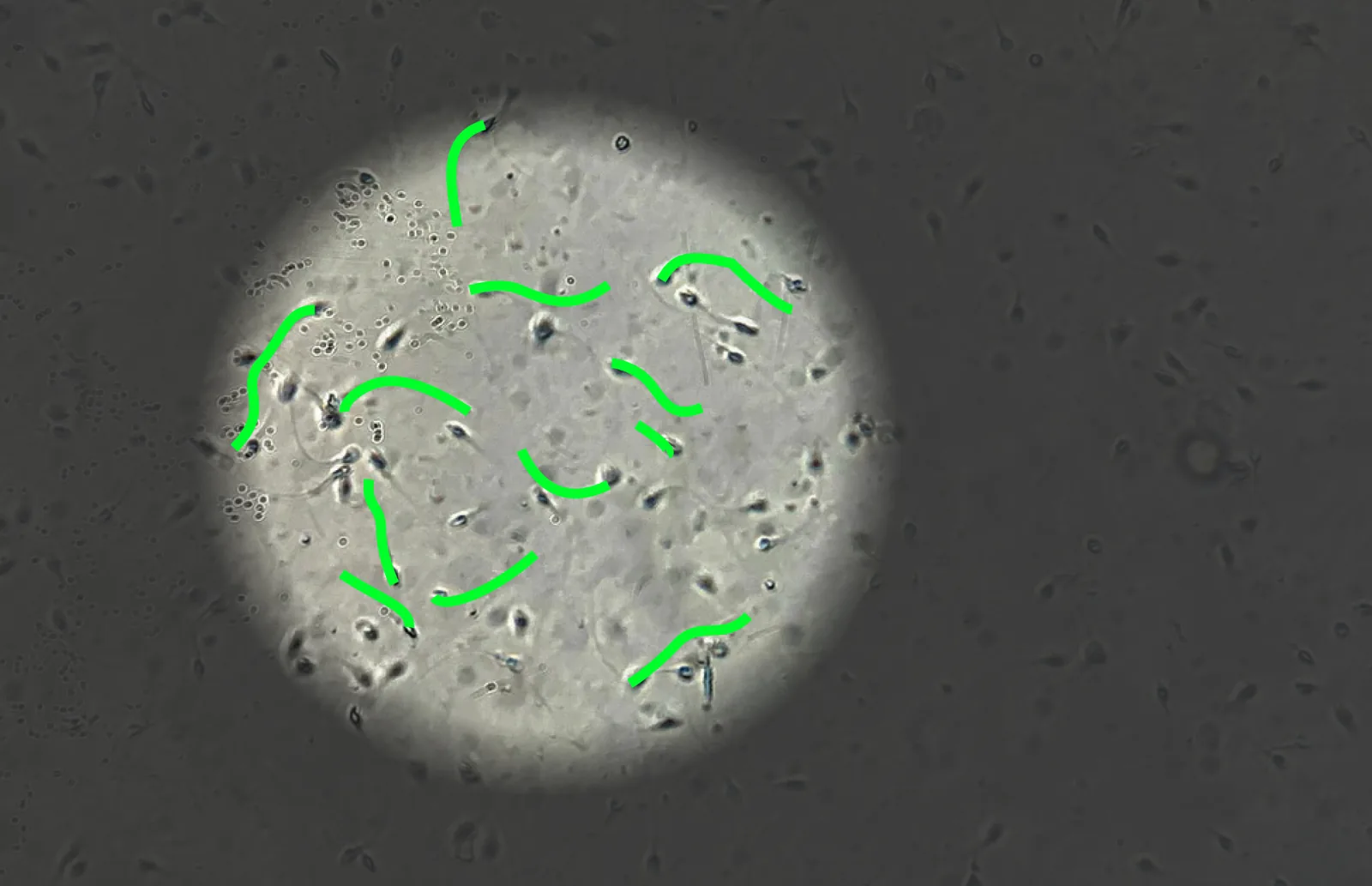
This is the distinction most field errors come from. A sample can look busy under the microscope, with lots of movement, and still have poor progressive motility. The sperm are twitching in place, not advancing. Reading total motility and calling it good is how a bad dose passes a field check.
The parameters: from simple to detailed
Motility is not one number. It is a family of parameters, from the two anyone can estimate by eye to the detailed velocities a CASA system measures.
The two that matter most in the field
- Total motility (%): the percentage of sperm showing any movement. Easy to estimate, but weakly tied to fertility on its own.
- Progressive motility (%): the percentage moving actively forward in a straight line. This is the field standard for judging a dose.
The kinematic parameters (measured by CASA)
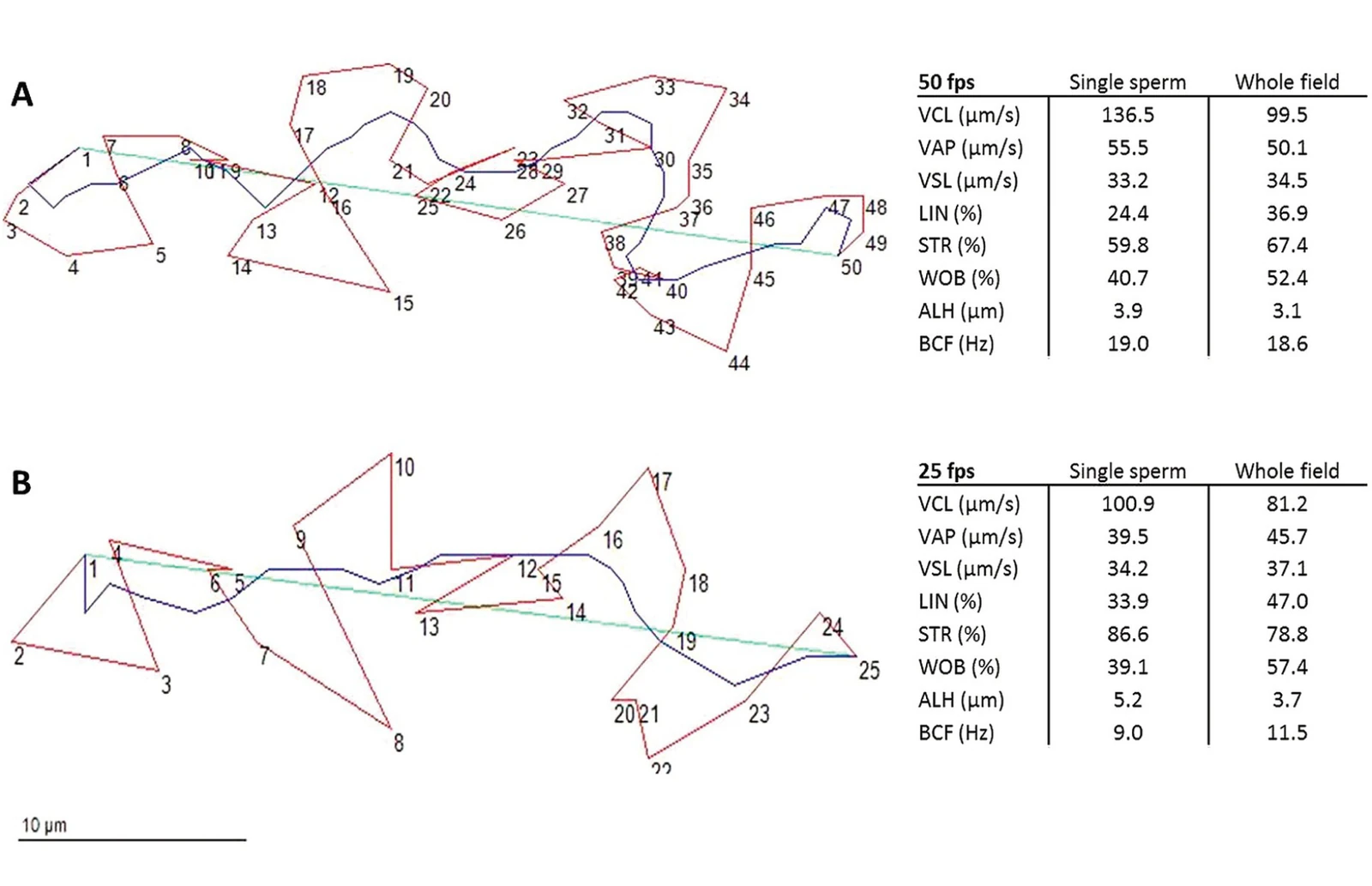
A Computer-Assisted Sperm Analysis system tracks each sperm head and calculates its motion in detail. These are the standard values, defined per WHO and CASA terminology:
- VCL, curvilinear velocity (µm/s): velocity along the actual wiggly path the sperm swims. The raw speed.
- VSL, straight-line velocity (µm/s): velocity measured straight from start to end of the track. How much real forward progress was made.
- VAP, average path velocity (µm/s): velocity along the smoothed average path.
- LIN, linearity (%): VSL divided by VCL. How straight the track is.
- STR, straightness (%): VSL divided by VAP. How closely the path follows a line.
- WOB, wobble (%): VAP divided by VCL. How much the head oscillates around its path.
- ALH, amplitude of lateral head displacement (µm): the width of the sperm head's side-to-side swing.
- BCF, beat-cross frequency (Hz): how often the head crosses its average path.
These separate a sperm that is fast and straight from one that is fast but going nowhere. A common definition of a progressively motile sperm is one with VAP above 25 µm/s and STR above 80 percent. The velocities also carry meaning beyond motility. VCL, VSL, and VAP have all been linked to sperm DNA integrity, so kinematics hint at quality a simple percentage misses.
How motility is evaluated
There are three ways to read motility, and they trade off accuracy, cost, and where you can do them.
Visual estimation
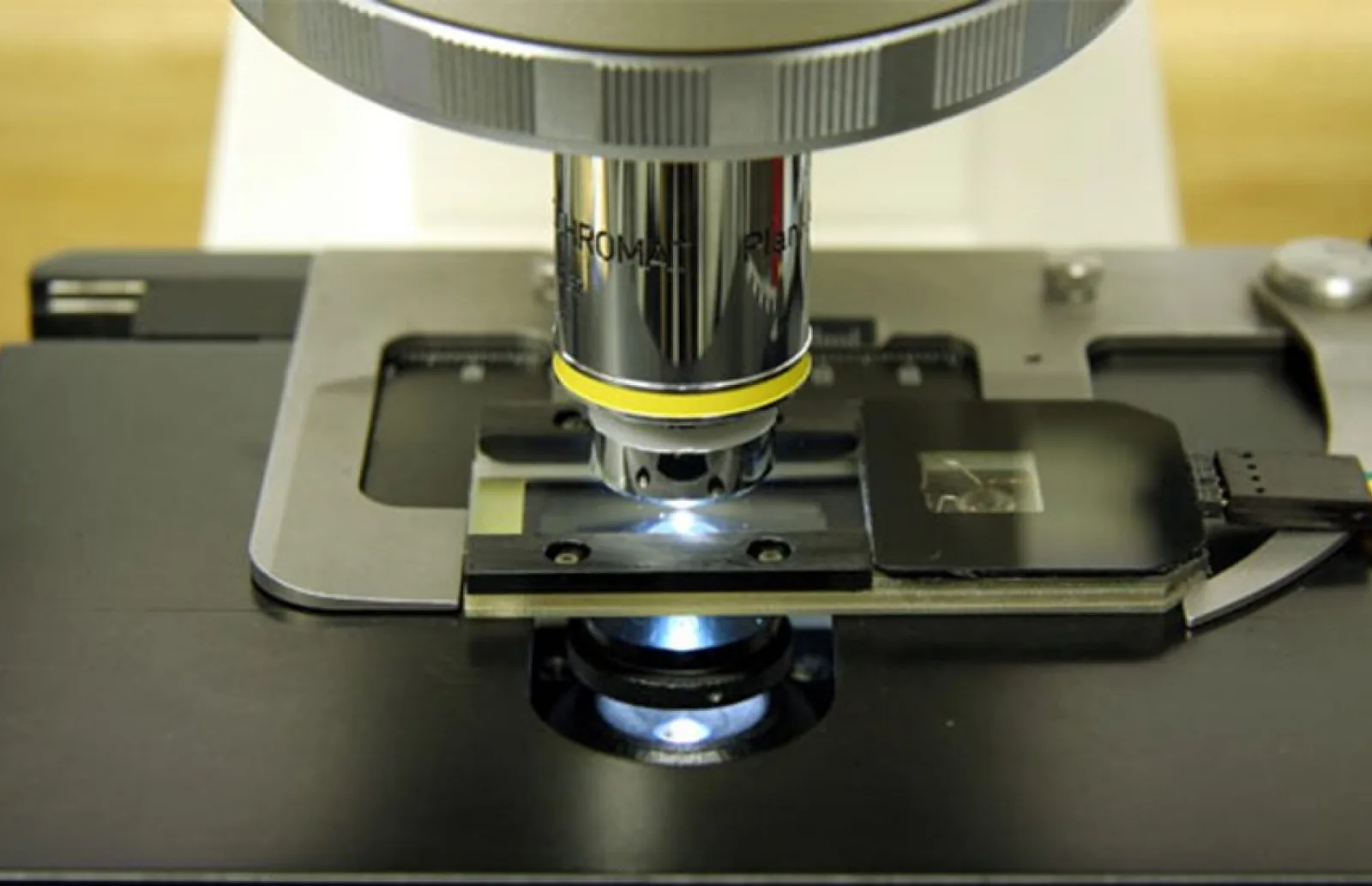
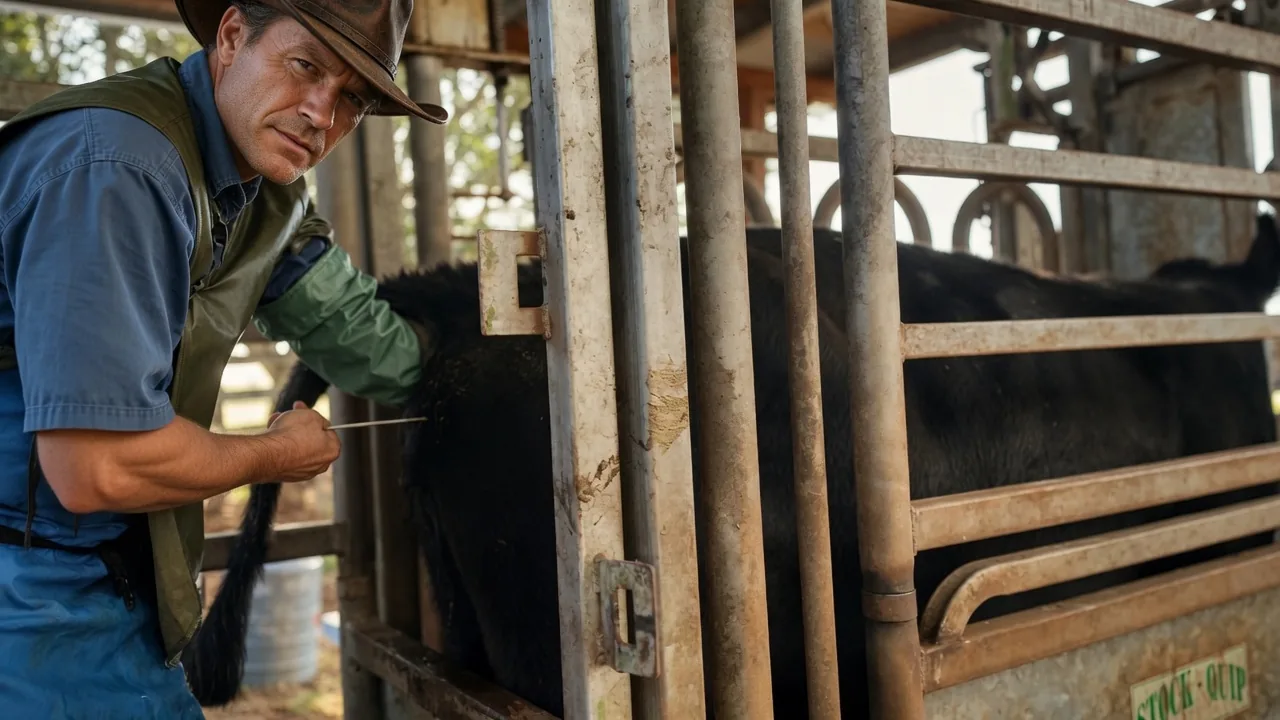
A technician places a drop on a warmed slide and estimates motility under a microscope. Fast, cheap, works anywhere. The weakness is subjectivity. Intra-sample motility estimates can vary by 30 to 60 percent, and two technicians reading the same drop often disagree. Fatigue and a cold slide make it worse.
Laboratory CASA
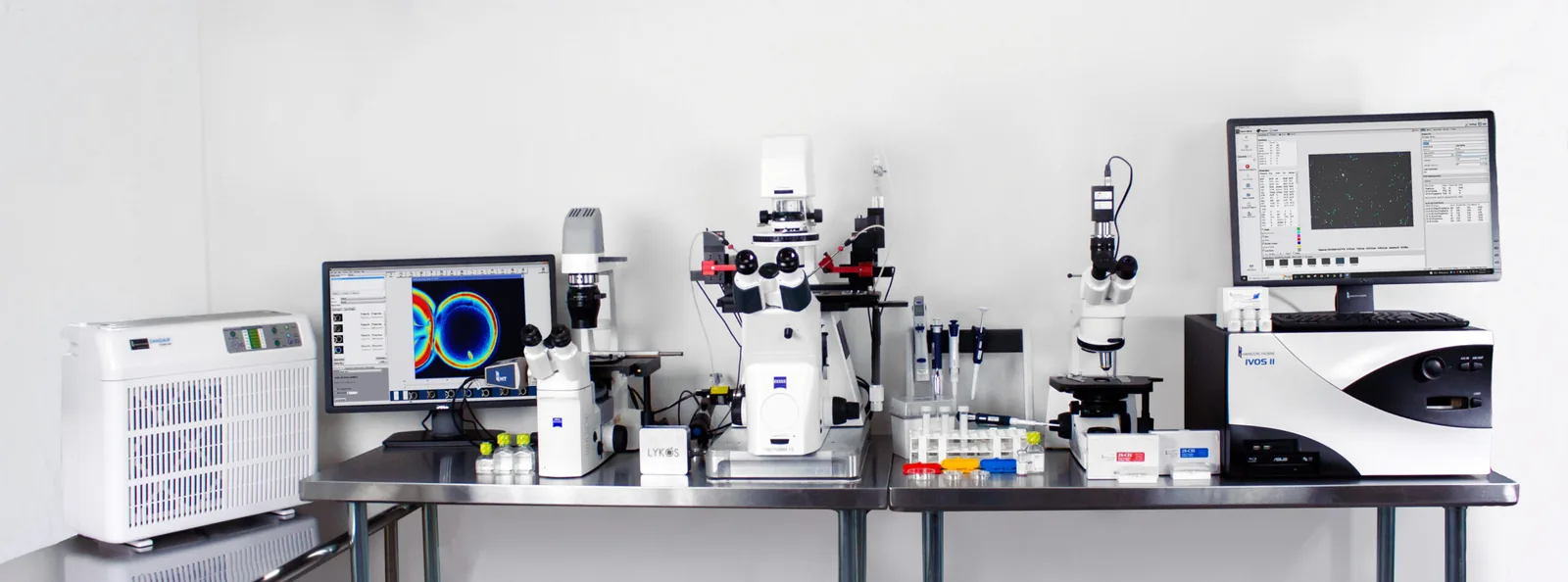
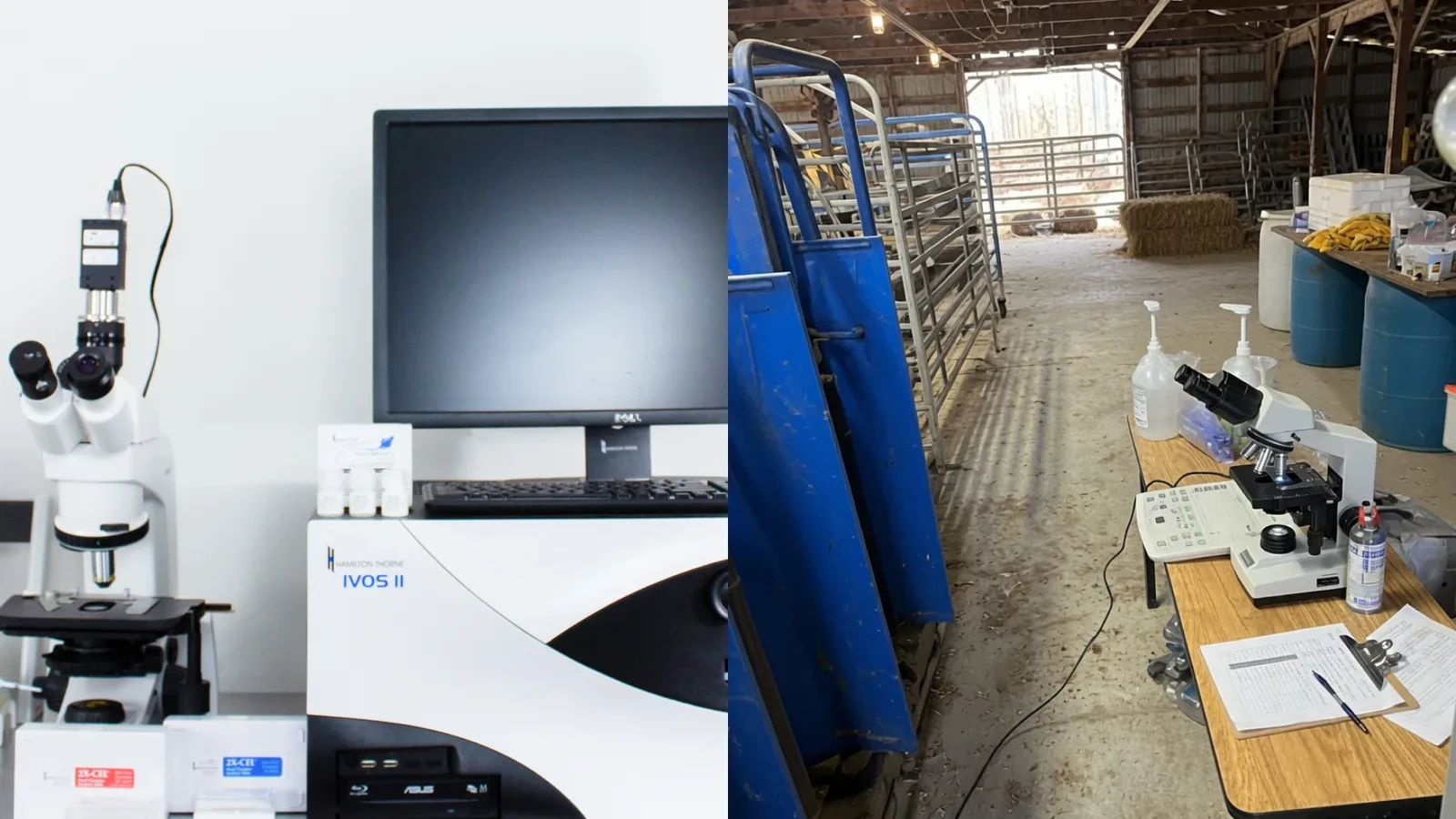
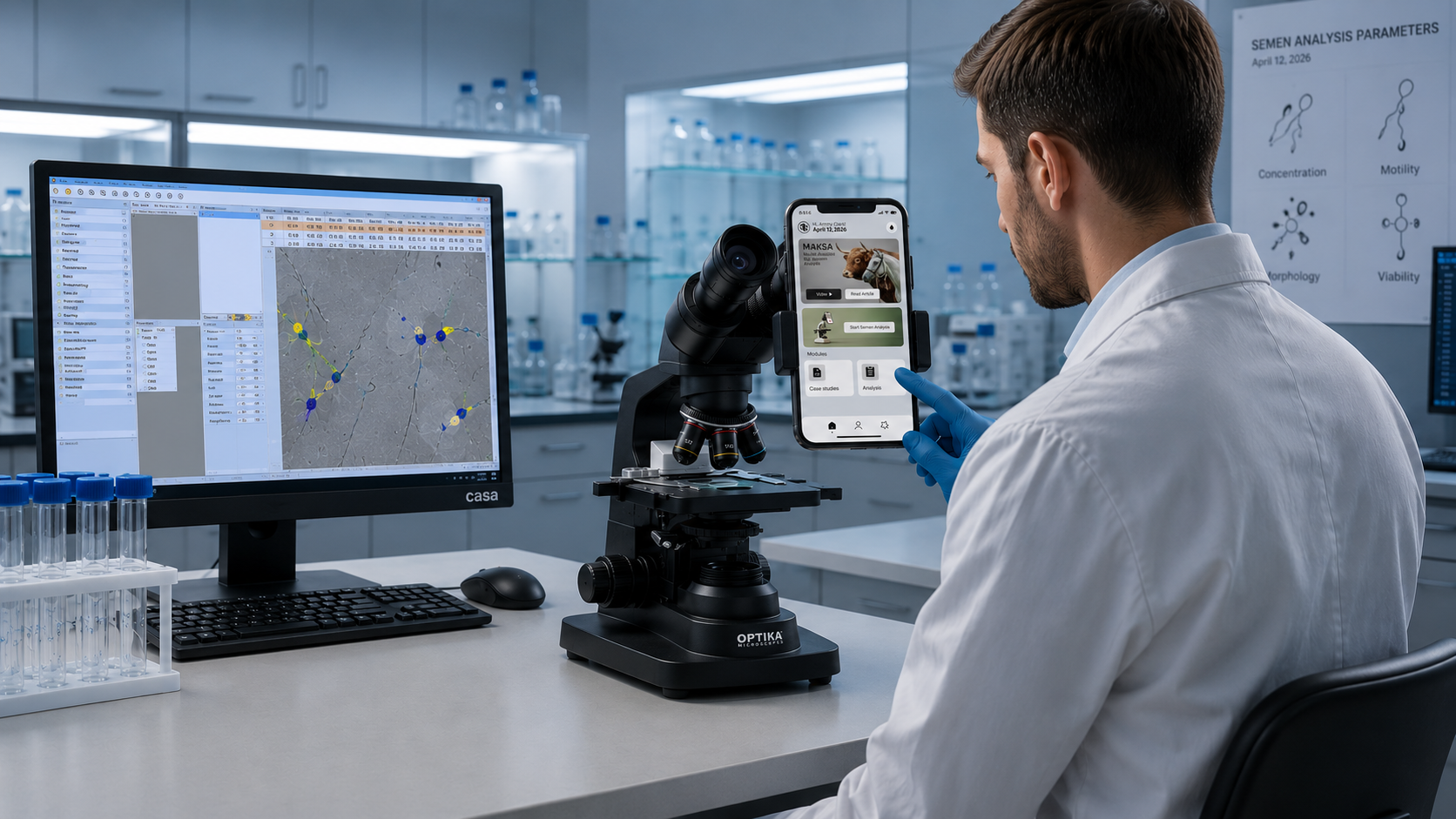
A benchtop CASA system like the Hamilton Thorne IVOS II tracks every sperm and returns objective motility plus the full kinematic set. It is the reference standard for accuracy and repeatability. The limitation is that it lives in a lab. The dose has to come to the machine, which means the field, where most doses are actually used, goes unmeasured.
Smartphone-based field analysis

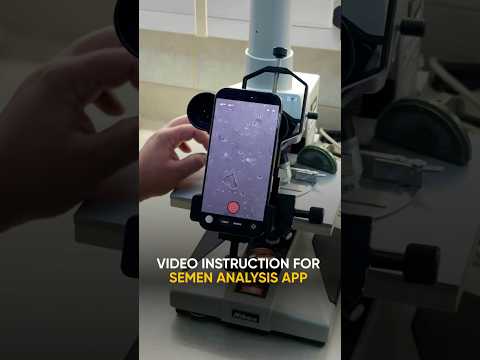
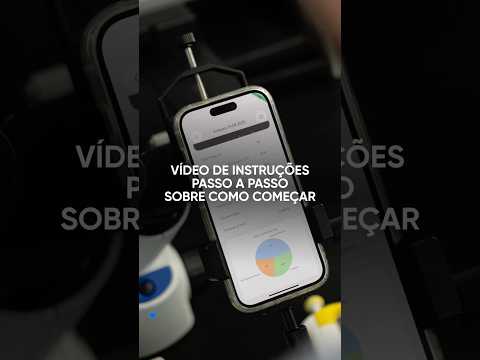
The newer option reads motility objectively where the dose is used. MAKSA reads total and progressive motility from a microscope and a smartphone, on the farm, in minutes. Across 1,000+ field tests in 10+ countries, the pattern we see is consistent: this closes the gap between the lab and the point of use, where a visual guess used to be the only choice. It is validated at r greater than 0.90 against laboratory CASA for motility and progressive motility, across five species: bovine, equine, ovine, caprine, and camel. It is a veterinary tool, not for human use. Concentration measurement is still in development, so it is not presented as a finished feature. A phone mount at the eyepiece gives steadier footage and better results.
Field standards: what counts as a usable dose
A number means nothing without a threshold. For bovine semen, the accepted field threshold for an acceptable breeder is above 30 percent individual progressive motility, the standard used by the Society for Theriogenology. Some organizations set the bar higher. Well-handled frozen-thawed doses often read well above the minimum.
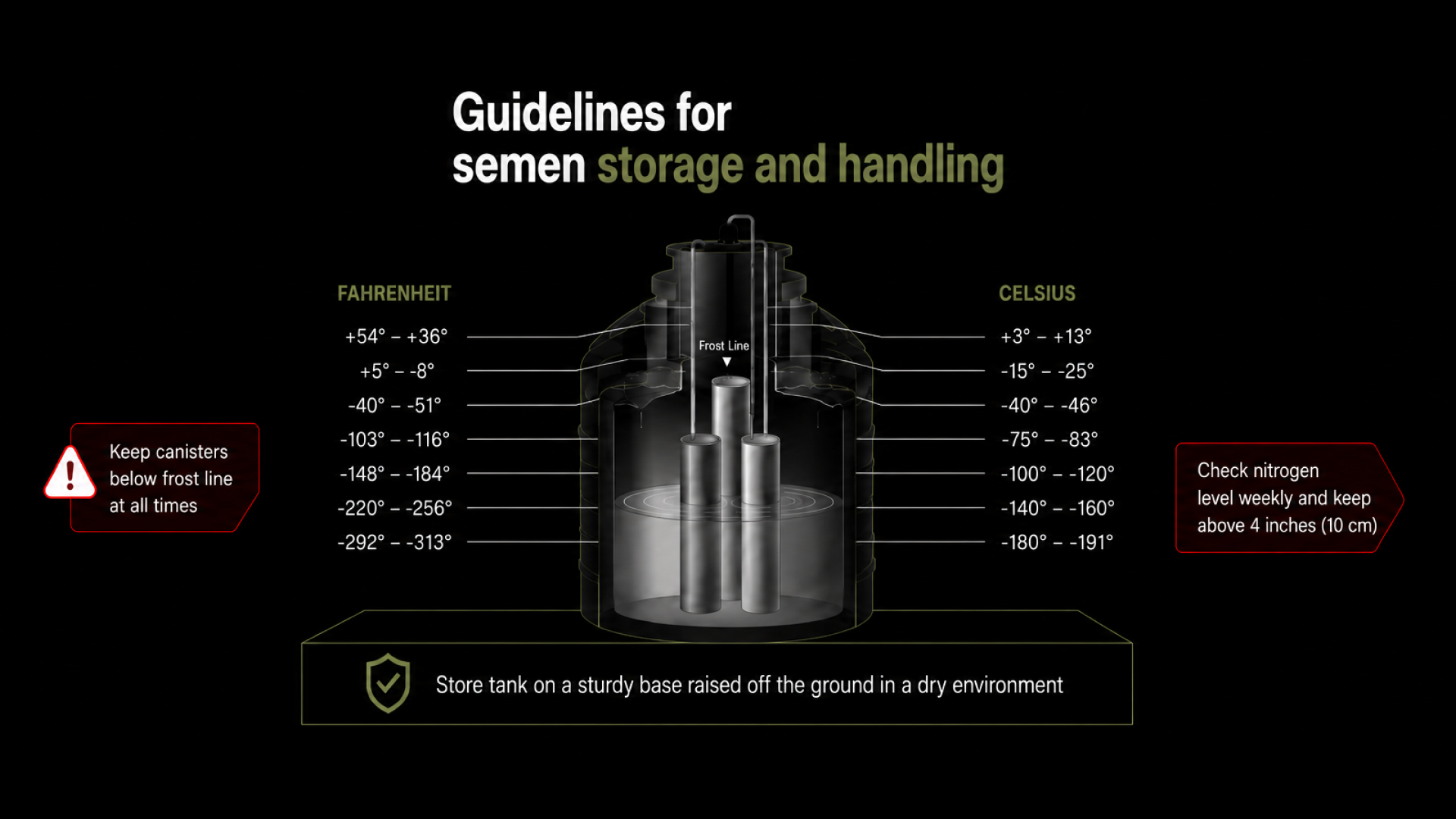
Two rules make any reading honest. First, temperature. Sperm suffer cold shock the instant they touch a cold slide, so the microscope stage and every surface must be held at 37 to 39 degrees Celsius. A cold slide alone can make a good dose fail. Second, timing. Motility falls after thawing. In one CASA study, progressive motility dropped from around 43 percent at 30 minutes post-thaw to around 32 percent at 2 hours. Read within 30 minutes, and thaw at 37 degrees for 30 seconds.
Skip either rule and the number lies, no matter how you measured it.
Why the field number is the one that counts
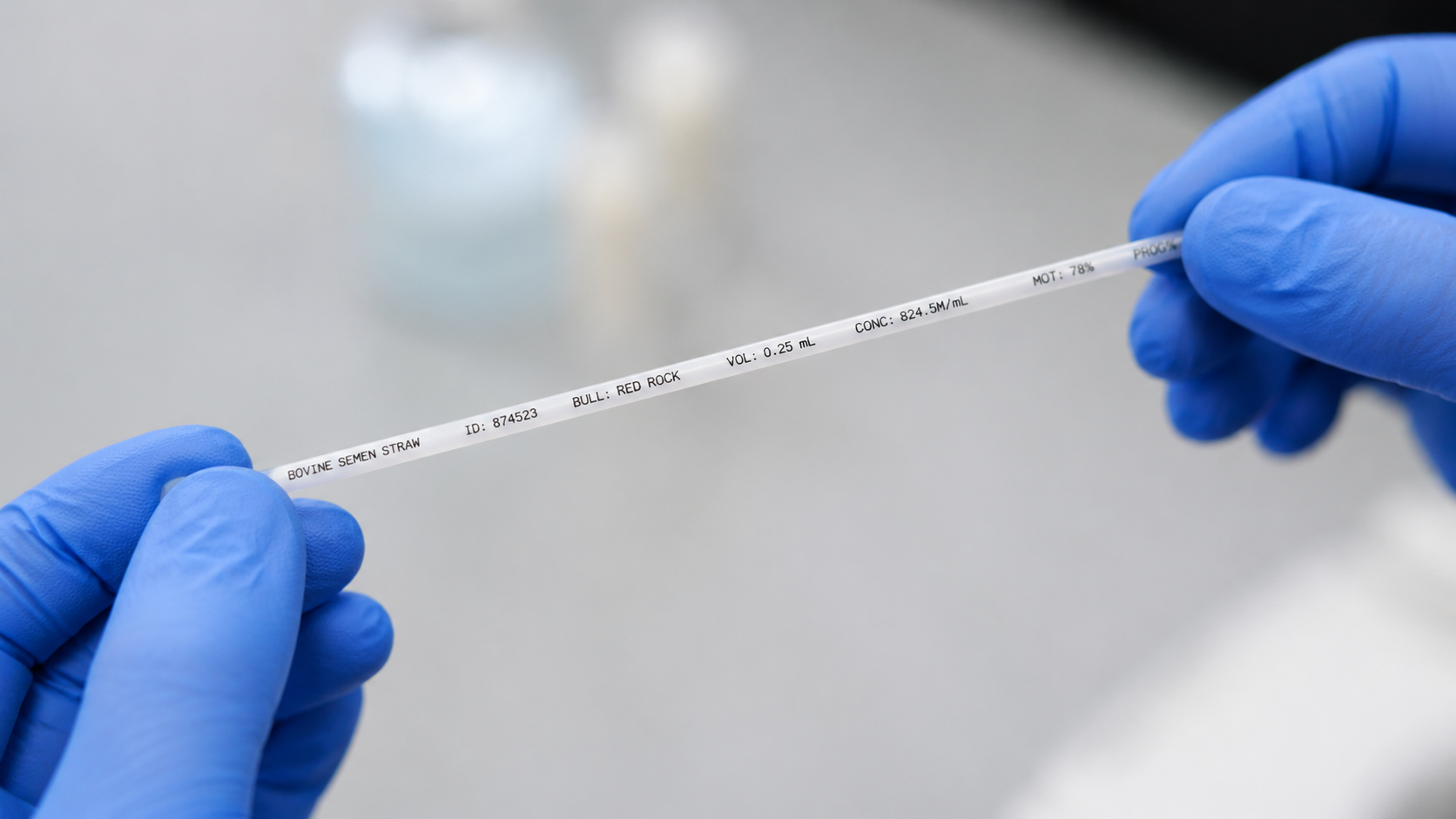
A certificate tells you motility at the center, on the day of freezing. It does not tell you motility today, in your tank, on your farm. Between those points, motility can only fall.
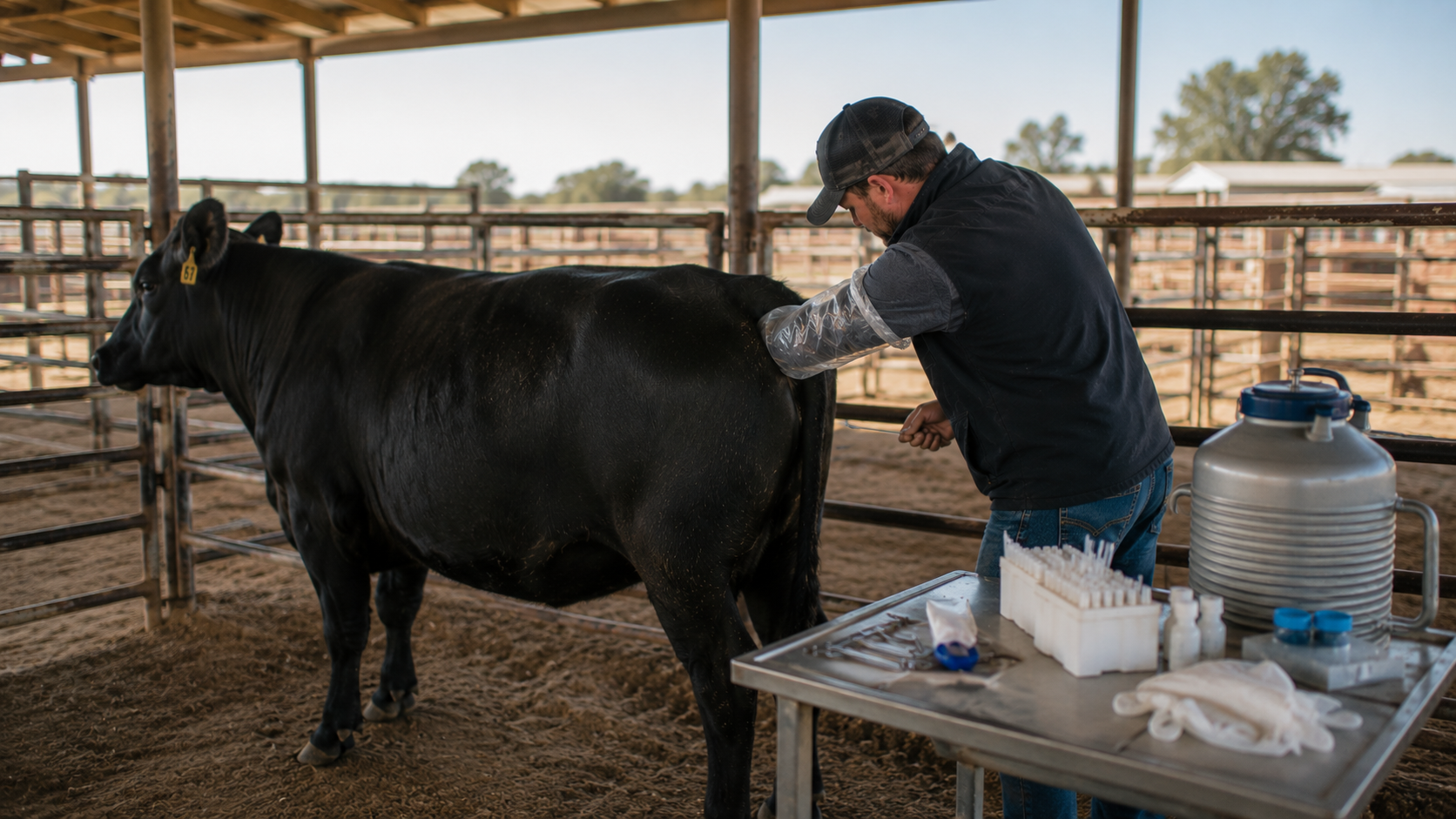
Think about it the way a technician does. Bull 47 gives a low season. Was it bull 47, or was it a warm tank, or a thaw that ran cool that morning? The certificate cannot answer that. Only a reading at the point of use can. That is why field motility, measured right before insemination, is the number that actually predicts what happens in the cow.
What actually predicts fertility

Sperm motility is not one number, and total motility is not the one that matters. Progressive motility is. Read it at the point of use, under temperature control, within 30 minutes of thawing, and you know whether a dose is worth using. Everything else is context.
Get that reading right and you stop confusing a busy sample with a fertile one. You also stop blaming bulls for problems that live in the handling.
Frequently asked questions
What is the difference between total and progressive motility? Total motility is the share of sperm showing any movement. Progressive motility is the share moving forward in a straight or nearly straight line. Progressive is the one tied to fertility, because only forward-swimming sperm reach the site of fertilization. A sample can have high total motility and poor progressive motility if the sperm are moving in place.
What is a good sperm motility percentage for bovine AI? The accepted field threshold is above 30 percent individual progressive motility, the standard used by the Society for Theriogenology. Some organizations use higher cutoffs. Well-handled frozen-thawed doses often read higher, so a low progressive reading on a certified dose usually points to a handling problem.
What are VCL, VSL, and VAP in sperm analysis? They are velocity parameters measured by CASA. VCL, curvilinear velocity, is speed along the actual wiggly path. VSL, straight-line velocity, is speed straight from start to end of the track, meaning real forward progress. VAP, average path velocity, is speed along the smoothed path. Ratios like LIN (VSL/VCL) and STR (VSL/VAP) describe how straight the swimming is.
How is sperm motility measured in the field? A drop is placed on a warmed slide and read under a microscope with a 37 degree stage at 200x to 400x, estimating progressive motility. This visual method is fast but subjective, varying by 30 to 60 percent. A smartphone tool like MAKSA reads motility objectively from the same microscope, turning the estimate into a measured number.
Why does sperm motility drop after thawing? Because thawing and the time after it stress the sperm. Progressive motility falls from roughly 43 percent at 30 minutes post-thaw to around 32 percent at 2 hours in one CASA study. Thawing at the wrong temperature, or leaving a dose too long before use, accelerates the loss. Thaw at 37 degrees for 30 seconds and use within 30 minutes.
Can a smartphone measure sperm motility accurately? For total and progressive motility, yes. MAKSA reads both from a microscope and a smartphone and is validated at r greater than 0.90 against laboratory CASA equipment. Concentration is still in development, so it is not presented as a finished feature, and the tool does not replace a certification lab. For a field motility reading it gives a number instead of a guess.
Low conception this season? Start with motility
Poor motility, measured or unmeasured, is one of the most common reasons an FTAI season underperforms. But it is rarely the only one. We wrote a field guide to the seven causes that quietly pull conception down, from heat stress and body condition to handling and recording gaps, with a diagnostic you can run when a batch comes back low.
Enter your email to get the guide, 7 Reasons Your FTAI Conception Rate Is Low, with the field protocols, at avateit.com. Free, built for reproduction vets and IATF technicians.